Back to blog
MVP to fintech-grade: what changes when money, compliance, and real users enter the picture

Most advice about building an MVP assumes the same starting point: a small team, a rough idea, and permission to get things wrong quickly. Ship something thin, watch how people use it, fix what's broken, repeat.
That advice holds up fine for a to-do list app or a content tool. It breaks down the moment your product touches money, personal data, or a regulated workflow, which describes most fintech products from day one.
A fintech MVP isn't a smaller version of the eventual product so much as a different kind of build, one with a much shorter list of things you're allowed to get wrong.
The MVP mindset assumes cheap mistakes
The core promise of "move fast and validate" is that mistakes are recoverable. Ship a clunky onboarding flow, learn it converts poorly, redesign it next sprint. Ship a feature nobody uses, cut it. The cost of being wrong is a few weeks of engineering time.
That assumption is what makes MVPs fast. It's also what makes them risky in fintech, because some mistakes stop being cheap the moment real money or real financial data is involved:
- A rounding error or race condition in a payment flow turns into a reconciliation problem, and possibly a compliance one, long before anyone files a bug report.
- Mishandled KYC/AML data during onboarding is a regulatory matter, not a UX one.
- An access-control gap in a financial dashboard is a breach, however it gets labeled on the sprint board.
None of these are hypothetical edge cases you patch after the demo goes well. They're the parts of the product that have to be right in the first release, because "we'll fix it in v2" isn't a workable answer for money movement, compliance, or user trust once the product is live.
What still gets to move fast
The instinct after reading that list is often to over-correct: treat the entire MVP as high-stakes and slow everything down. That's the wrong lesson. Most of an MVP should still be exactly what it always was, a focused first version built to answer real product questions, not a hardened system built to withstand every edge case.
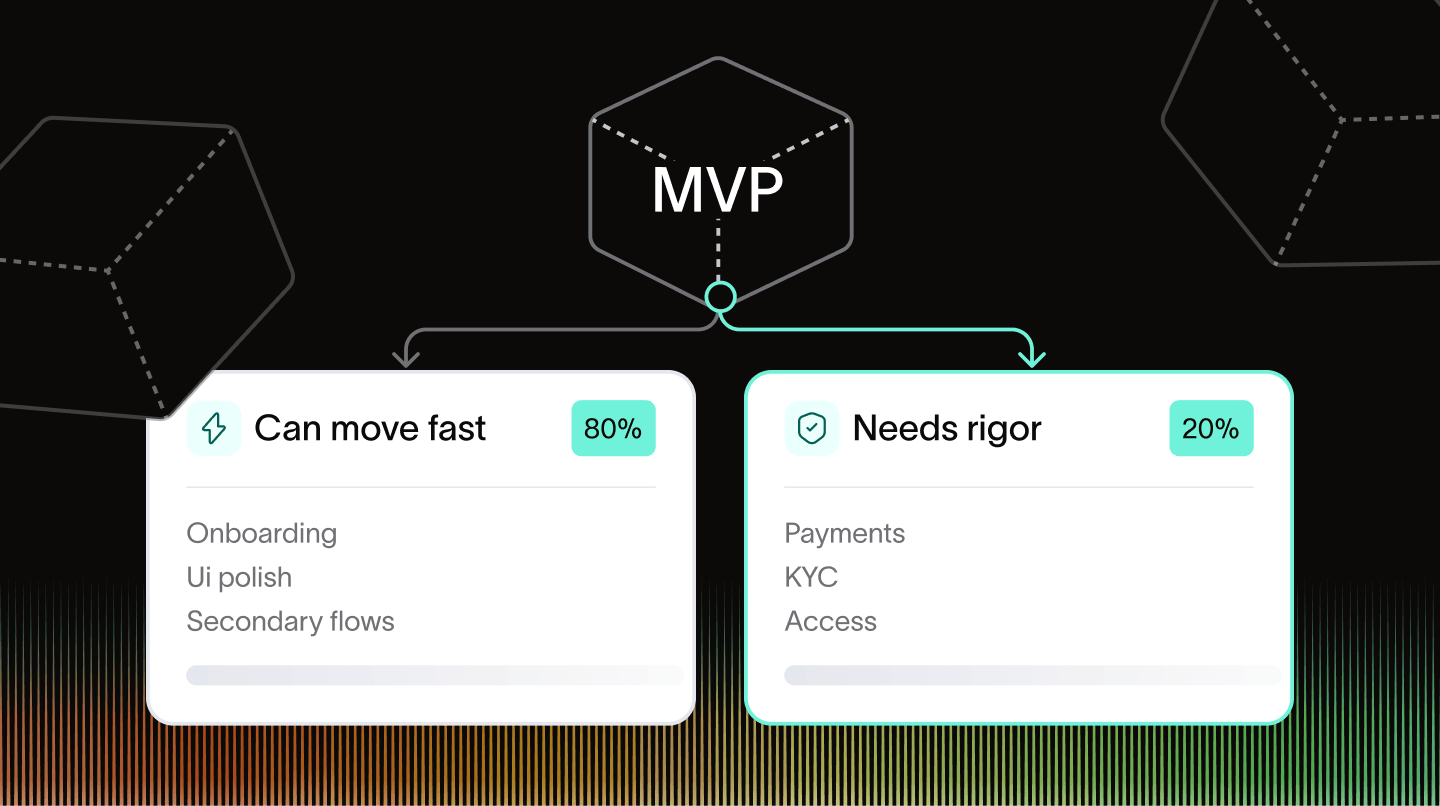
What actually matters is knowing which 20% of the product carries fintech-grade requirements and which 80% can still move at normal MVP speed. Treating the whole thing as high-risk is just as much a scoping failure as treating none of it that way.
Fast-moving, safe-to-iterate territory usually includes:
- Onboarding copy, UI polish, and secondary user flows
- Non-financial features and settings
- Which metrics to track and how to present them
- Most product-market-fit questions: pricing, positioning, feature prioritization
Slow-down-and-get-it-right territory usually includes:
- Anything that moves, stores, or displays money
- Identity verification and KYC/AML flows
- Data handling for personal or financial information
- Authentication, authorization, and access control
- Integrations with banking rails, card networks, or other regulated infrastructure
A well-scoped fintech MVP draws that line explicitly, early, with the team. Not implicitly, discovered later when something breaks in production.
Two ways fintech MVPs go wrong
In practice, teams tend to miss this line in one of two directions.
Under-engineering everything, because "it's just an MVP." We see this most often with first-time fintech founders. The team applies standard startup instincts across the board, ship fast and iterate later, without carving out the subset of the product that can't actually work that way. The gaps tend to surface months after launch: a security review, an investor's technical due diligence, or a partner bank's onboarding process turns up how identity data was handled or how payment state was tracked. Fixing it then costs far more than doing it right the first time, in engineering hours, and in the credibility hit with whoever found the gap.
Over-engineering everything, because "it's fintech." Here the whole product gets treated as if it carries the same regulatory weight as the payment core. Teams spend weeks hardening a settings page or building infrastructure sized for scale the product hasn't earned yet, while it still needs to prove anyone wants it. It's a cheaper mistake than the first one, but not a free one: it burns runway and time-to-market on rigor the product doesn't need, and it's usually a sign the team doesn't have enough fintech experience to know where the real risk sits.
Both come down to the same missing step: scoping the risk explicitly, feature by feature, up front, instead of defaulting to one posture for the entire product.
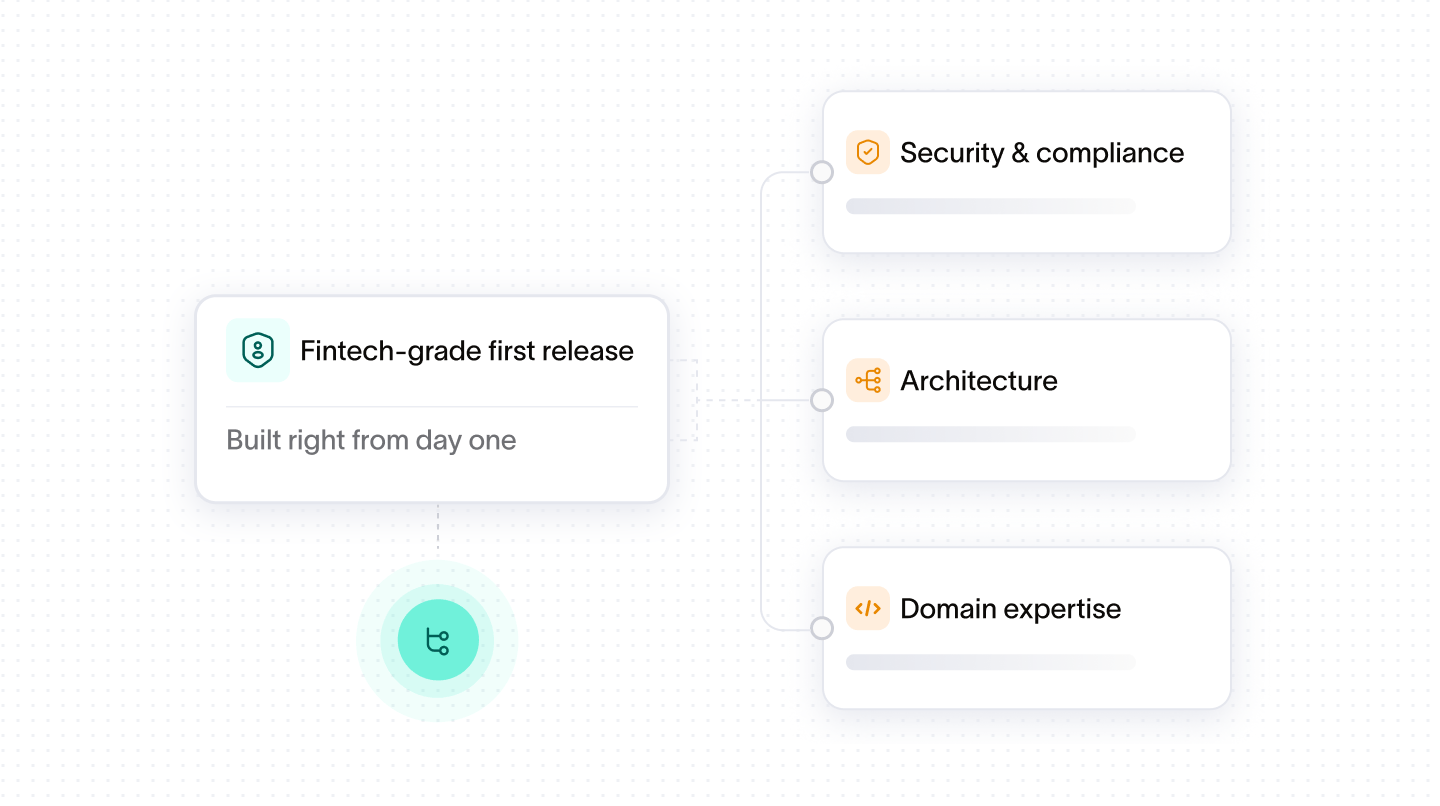
Three things a fintech-grade first release gets right from the start
Security and compliance are part of the build, not a phase after it. Automated testing, CI/CD, and security review belong in the delivery pipeline from the first sprint. For anything touching money or sensitive data, that also means independent verification: third-party penetration testing before the release goes live, not a checkbox added once a client or regulator asks for it.
Architecture decisions are made with the second release in mind, even in the first one. You don't need to build for a million users on day one. But choices around data models, authentication, and integration boundaries are expensive to unwind later. Expensive enough that it's worth spending a bit more time getting them right the first time, even inside an otherwise lean MVP.
The team understands the domain, not just the tech stack. Building a KYC flow, a payments integration, or a compliance-sensitive dashboard goes faster and safer when the people writing the code have done it before and know where the real risks sit, versus a generalist team learning fintech constraints for the first time on your product.
What this means if you're scoping an MVP right now
If you're a founder or product lead about to start (or restart) a fintech MVP, three questions are worth answering before a single line of code gets written:
- Which parts of this product involve money, identity, or regulated data? Draw the line explicitly. Everything on that list gets extra rigor; everything else can move at normal MVP speed.
- Who's verifying the risky parts? Internal review is necessary but not sufficient for anything fintech-grade. Plan for independent security testing before launch, not after an incident.
- Does the team building this understand fintech constraints, or are they learning them on your product? That difference shows up in how many things need to be rebuilt six months in.
Timeline and cost deserve a straight answer too. A fintech-grade MVP usually takes somewhat longer and costs somewhat more than a comparable non-regulated one. Not because the whole product got more complex, but because a small, high-risk surface (payments, identity, access control) now needs proper design, testing, and independent verification before launch. Budgeting for that up front is cheaper than finding out about it later, as a delay, when a compliance review, an investor, or a banking partner asks a question the product wasn't built to answer.
The same logic carries past the MVP itself. A first release that gets the risky 20% right is cheap to extend into a stable product later. One that skipped it usually means rebuilding the payment logic or identity handling from scratch once real usage arrives. The MVP doesn't have to anticipate every future requirement. It just shouldn't be built in a way that works against them.
Where Base Blocks fits
We build MVPs for fintech and other complex, compliance-sensitive products, with a senior, AI-enabled product, design, and engineering team, not a rotating cast of juniors learning the domain as they go. Automated testing, CI/CD, and security testing (including third-party penetration testing for fintech and other sensitive releases) are built into how we deliver from day one, so speed doesn't come at the cost of reliability.
If you're scoping a fintech MVP and want a second opinion on where to move fast and where to slow down, book a strategy call. We're happy to talk through the specific product before any commitment.
August 10, 2026